29.11.10

"Flow" by Philip Ball
A study of the science of flow that offers many pleasures to the reader (but a clear statement of the book's aims is not one of them)
This is another of Philip Ball's quirky, scholarly, illuminating studies of the patterns of nature, the second in a trilogy. The others deal with shapes and branches; this one deals with flow of all kinds, from convection in the sun to avalanches in a pile of rice.

Ball has struck popular science gold with this trilogy, because he has a subject matter that is at the same time scientifically intriguing, visually engaging, and easy for the layperson to grasp. Fluid flow -- the paradigm of flow in this book -- is a typical case. Eddies and turbulence are interesting for scientists because they are horribly complicated. But because they are horribly complicated, the only hope of understanding many features of fluid flow is through a kind of simple qualitative modelling, the kind that is easy to explain to a popular audience. The Kelvin-Helmholtz instability, for example, is a mechanism by which flowing water forms wavy currents. It is a simple mechanism, communicable in a picture, and it creates delicate plumed patterns in water that make great images. And like most of the patterns in this book, it crosses mediums easily -- it is present in clouds as well as rivers.It turns out, as Ball reveals in the last chapter of the book, that real turbulence is not susceptible to any simple models like the Kelvin-Helmholtz model. But this is a rare exception. And even with turbulence Ball finds a pretty way of illustrating the science: he concludes as he began the book, with a work of art. This artistic theme -- the first chapter is about representations of fluid flow in Western and Eastern art, with a focus on Leonardo Da Vinci -- is typical of Ball's playfulness in this trilogy, his fondness for interesting diversions. These are indeed diverting, but they can also be disorientating. In the case of this volume, I finished the first chapter without having much idea of what the book would be about.

This book is certainly about something, though, even if it that something is hard to pin it down. It's about fluid motions, of course: aside from the conventional topics of water flow and convection, we have intruiguing chapters on the collective behavior of grains (in dunes, piles, and sheets) and on the movement of flocks of animals, crowds of people, and lines of traffic. But it's also about deeper themes, which Ball mentions now and then but explains systematically. It's about trying to describe and understand a wide class of phenomena through a single parameter -- whether it is Rayleigh's number for describing the tendency of fluids to give convection patterns, or Reynold's number for describing the eddy-forming habits of a liquid stream. In a vague way it is about self-organisation, the capacity of macroscopic entities to form complex patterns with no outside help except a steady influx of energy. And in a fleeting way it is also about self-organising criticality, the quality that some phenomena have of spontaneously entering highly unstable states -- a quality that the now-legendary sand-pile is supposed to have.

Readers who are not interested in these themes, perhaps because they would rather see them treated front-on rather than in the occasional sidenote, will still find plenty to enjoy in this book. The simplest pleasure it offers is to witness similar patterns in disparate phenomena: lane-forming on human footpaths and in the trails of army ants; convection not just in boiling water but inside the earth, in clouds, in cereal packets, and in the regularly-spaced circular craters that shape some landscapes in Norway and Alaska. Another of the book's pleasures is its narration of the process of science, the sequence of attacks by different scientists, using different methods, on the same problem. In Flow, Ball's account of successive attempts to explain sand dunes is typical of his blow-by-blow coverage of the process of discovery.

The breadth and detail of Ball's interests in this book means there are many other pleasures besides, from the historical (Faraday's prescient thoughts on convection in grains) to the domestic (an explanation of why shaking a cereal packet drives the chunky bits to the top). The downsides are that the scientific detail is sometimes heavy-going, and that the underlying themes of the book (aside from the general idea of fluid motion) are nebulous. On a more specific note, Ball's discussion of self-organising criticality did not ease much of my confusion about that topic. On the whole, however, Flow deserves its place in Ball's trilogy -- and that is high praise.
[read more]

18.11.09

Are all environmentalists hypocrites?
Maybe, but it's better to be hypocritically active than honestly inactive

Hypocrisy is a useful tool for environmentalists. Show the world that Shell is tearing up the sands of Alberta and the world shrugs. Show the world that Shell is tearing up the sands of Alberta, and at the same time advertising themselves as a green company, and the world pricks up its ears. Dishonest wrong-doing carries more weight than mere wrong-doing.

But hypocrisy is one of those tools that can easily turn on its users. Those who make moral claims are expected, on pain of hypocrisy, to back them up with unambiguous action -- environmentalists included.

This is fair enough, but sometimes it seems to go too far. Tell someone you've quit meat to reduce carbon emissions, and friends and foes alike will wonder aloud why you are still driving a car, buying imported fruit, etc. etc. Spend a year living cashfree and a mob of commenters will call you a hypocrite for submitting a blog post by broadband. It seems that people who try to do good, and succeed imperfectly, are more guilty than people who don't try at all. Is this fair?

The hypocrisy of some actions is indisputable, and indisputably a vice. Shell's hypocrisy is worse than mere wrong-doing because it is a lie designed to downplay the extent of their wrong-doing. Is it just as bad to be a selective environmentalist, one who picks and chooses their good works depending on what is convenient for them (assuming that leaving a Western-sized carbon footprint is a wrong-doing)?

There has been a lot of scholarly ink spilt on the nature of lying and on whether or not wrong-doers forfeit their right to complain about the actions of others. Which is to say that it would be easy to get one's knickers in a philosophical twist on the topic of hypocrisy.

But the following points seem to me salient, obvious, and within the grasp of people (like me) who want to think about this issue but do not want to think too hard.

Firstly, it is not a good thing for an individual to be deluded about the extent of the harm he inflicts on the world, for the simple reason that such an individual is less likely to reduce the harm they inflict.

Secondly, in at least some cases it is wrong for an individual to deceive others about the extent of his wrongdoing. If I put it about among Ethiopians that I was down to 1.2 tonnes of CO2 a year when in fact I was not, then I would be a lot like Shell when they put it about among Britons that they are a clean company when in fact they are pumping Alberta's dirt into the atmosphere.

Thirdly, a person who takes some action to reduce their carbon footprint, but not all possible action, does not automatically deceive himself or anyone else. It might be perfectly clear in his mind that his actions are of real but limited use, and he may never lead anyone to believe otherwise.

Fourthly, it is better to take some good action on climate change, and be a bit deluded or dishonest about the value of those actions, than to take no action at all now or in the future. A population of frank and knowing individuals is not much use if none of them reduce emissions.

Fifthly, and finally, the fear of being called a hypocrite should not stop people from making incremental changes to their lives in the interests of the environment (or in the interests of any other worthwhile cause). The fear of being a selective environmentalist should not turn people into timid environmentalists. The alternative is damaging, absurd, and selfish.

It would be damaging because most environmentally-friendly action by individuals will be step-by-step action. Wipe out incremental action and you wipe out most action.

It would be absurd because the charge of hypocrisy assumes that the accused party has some wrong-doing to hide: I would be a lier, but not a hypocrite, if I said I would do five handstands but only did three. So if the fear of being hypocritical has any bite, it should urge us to take more action, not less.

And it would be selfish, because -- if Lord Stern and the IPCC are even half-way right -- the social inconvenience of being called a hypocrite is minute compared to the harm that will be avoided if individuals take real action on climate change. Hypocrisy on climate change is a bad thing, from Shell or anyone else. But inaction is much worse.

[read more]

16.11.09

"Science and Islam" by Ehsan Masood
An accessible and enlightening survey of Islamic science during the so-called Dark Ages and beyond
"Animals engage in a struggle for existence [and] for resources, to avoid being eaten and to breed...Environmental factors influence organisms to develop new characteristics to ensure survival, thus transforming into new species. Animals that survive to breed can pass on their successful characteristics to [their] offspring."

Is this Richard Dawkins writing in the 21st Century? Or Lamarck in the 19th? Or some godless renegade in 17th Century Europe? Not even close. The author is al-Jahiz, a science writer from 9th Century Baghdad. The surprising thing is not that an Islamic author could write such a thing so early, but that we are surprised to learn that he could -- that's what Ehsan Masood would say, at any rate. And readers of Science and Islam will probably agree with him by end of this lively and user-friendly book on Islamic science during the so-called Dark Ages and beyond.

Part 1 of the book mixes a potted history of Islam with descriptions of the patrons, institutions and practitioners of science in each major regime from 700AD to 1300AD. The story is long but compactly told. In the space of four chapters and seven centuries, Islamic science flowers in Damascus, Baghdad, and Egypt before being cut down by the Mongols and Tartars. Along the way Masood sketches some of the many colourful figures of the time, like the bird-man ibn-Firnas and the scientific advisor who is unable to build a damn on the Nile and feigns madness to avoid the wrath of his caliph.

Part 2 hones in on the science of this "staggering renaissance." Masood covers medicine, astronomy, mathematics, chemistry, and engineering, in that order, with a post-script on evolution, optics, and Islamic universities. When describing the heroes of Islamic science and their remarkable work, Masood keeps one eye on their Greek heritage and another on their European successors. Comparisons are odious, but illuminating: Islamic scientists are all the more impressive when we learn that they questioned Galen on medicine, challenged Ptolemy on cosmology, and made direct contributions to the work of Copernicus, Kepler, Fermat, Newton, and the engineers of the industrial revolution.

Part 3 looks at Islamic science in the 19th and early 20th century, and draws some lessons for the future. This is not just an epilogue. It asks what the scientific revolutionaries of the 17th Century thought about Islamic science, whether the Ottomans were wise to borrow from Western science in the 19th Century, and whether imperialist science was a good thing for India. These are all delicate questions with ambiguous answers, and Masood gives a balanced survey. To end, he picks up a thread that runs right through the book, the violence of pro-science Islamic rulers. "If science is to return to the nations of Islam," Masood concludes, "it must do so without interfering with people's freedom to believe."

This conclusion is wrong if taken too literally. Surely a belief in evolution (for example) will interfere with a person's freedom to believe that the earth was created 6000 years ago -- and rightly so. Still, Masood does well to remind us that dictatorial rule does not help the cause of science, even if the dictator is pro-science. This book also reminds us of another easy-to-forget truth: for most of its history, Islamic science flourished alongside the teachings of Muhammad, not in spite of them -- and sometimes, as for medicine, it flourished because of those teachings.

Science and Islam has some gaps. Sometimes Masood left me hanging after skipping past what seemed to be key achievements in Islamic science. One is the passage quoted at the top of this review, which summarises not just evolution but also a mechanism for evolution that resembles evolution by inherited characteristics; another is the controlled clinical trial conducted by the medic al-Razi to test the theory of bloodletting. Clinical trials and evolution are such monuments of modern science that I expected Masood to say more about their role in Islamic science. Also, Islamic science from 1300 to 1800 gets little attention -- which is fine for such a small book, but Masood does not explain the omission.

Topics that require equations or diagrams are not well-covered. When it comes to Islamic optics Masood gives 4 pages to theories of sight -- which are easy to describe qualitatively -- and only 2 paragraphs to refraction, reflection, and other theories of how light travels. The chapter on number gives a good survey of Islamic mathematicians but is light on algebra, perhaps their most important contribution in this field. A diagram or two in the chapter on astronomy may have clarified concepts such as the "Tusi couple", a mathematical tool for simplifying Ptolemy's model of the heavens. However, in place of technical detail the book has up-to-date scholarship, an asset for understanding the Islamic influence on Copernicus, the water clocks of al-Jazari, and numerous other topics.

Science and Islam faces the dual challenge of covering a technical subject (science) and a neglected period of history (the East during the Dark Ages). The book is aimed at a general audience, the majority of which will be unfamiliar with one or both of these topics. Masood answers both challenges well. His smooth prose and bite-sized format are easy on the novice palate (there is a new sub-chapter every 2 pages or so). All but the most learned readers will come away with their image of both science and Islam refreshed.
[read more]
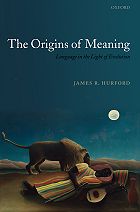
"The Origins of Meaning" by James H. Hurford
A detailed and scholarly, but accessible, survey of the evolution of linguistic meaning
This is unmistakably an academic book, more useful to the layperson as a reference than a bedtime read. But it is saved from 2 stars by the down-to-earth style of the author, which means that non-scientists can come to grips with its fascinating subject matter without too much effort.The grand-sounding title shows just how ambitious is the task that Hurford sets himself in this volume. His aim is nothing less than to show how the "semantic" and "pragmatic" sides of human language -- roughly, concepts and conversations -- grew out of the non-linguistic abilities of our distant ancestors. But anyone who expects a blow-by-blow narrative of how this happened, with the dates of each key development, will be disappointed. Instead Hurford describes the cognitive and behavioral abilities of non-humans that stand out as precursors to language, and then describes the evolutionary mechanisms that could have transformed these primitive capacities into the rich array of concepts and conversational skills that humans have today. The result is more flow-chart than timeline, a schematic account of how psychology, biology, and ecology combined to give modern-day linguistic meaning.

Hurford, Professor of General Linguistics at the University of Edinburgh, cuts no corners in surveying the theory and evidence that decades of scientific research have brought to bear on his topic. This makes the writing dense at times, as Hurford runs through studies, counter-studies, and rival interpretations of data. But it also makes the book an excellent starting point for anyone interested in exploring the topic further. Also, Hurford's comprehensiveness means he covers not just the evolution of language but also some large areas of general interest, like animal cognition and the evolution of cooperation.

The book is driven by academic rather than popular aims, but Hurford's prose makes it much more accessible than it could have been. The book covers an impressive range of specialty fields, from philosophy of mind to kin selection theory, so Hurford can't afford to lapse into the jargon of any one of these specialities. And he does a good job of keeping all readers in the loop, spelling out the meanings of technical terms and describing in plain language how each chapter fits into the bigger picture.

While readable, the book will be dry to anyone used to popular science writing. But the reward for the patient reader is a steady flow of probing questions, clever experiments, and curious findings. In what way is language a cooperative exercise? If language evolved by sexual selection, why are human males and females equally competent at language? What happens in a monkey's mind when it responds to an alarm call from a fellow monkey by running away? Is this behavior hard-wired, or does the momkey form a concept of "predator" in its mind and respond to that concept? What came first: pure speech acts that expressed sentences like "hello" or "I'm here", or descriptive statements like "That plant is poisonous"? Scattered among the answers to these and many other questions are quirky phenomena such as mice who dream, humans who understand lip-pointing but not finger-pointing, and pigeons who can distinguish between works from the Picasso and Monet schools of painting.

The argument running through the book is that non-human animals have more mental capacities than previously thought, and hence that the gap between the language abilities of humans and non-humans is smaller than previously thought. For a lay reader this is probably the most engaging and surprising aspect of the book: from the multiple alarm calls of the ververt monkey to the idea of "opposite" possessed by great apes, animal concepts and conversations are richer than we usually give them credit for. Of course sometimes the limits of non-humans is also clear -- for example, even a basic communication device such as pointing to refer to an object is very rare among our closest relatives in the wild.

This book is gristly and unsweetened, not recommended as light reading. But digested slowly, over many sittings, it is a feast of insights into the nature of language, animal cognition, the social role of communication, and the evolution of all three.
[read more]
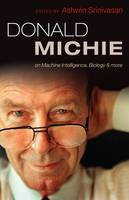
"Machine Intelligence" by Ashwin Srinivasan
An enjoyable collection of writings by a pioneer of AI and IVF
This is an eclectic collection of writings by and about Donald Michie, the Scottish-born scientist whose career spanned over half a century and covered many topics, most notably computer science and reproductive biology. Michie died in a car accident in 2007, aged 84, and "Machine Intelligence" is a tribute to his life and work compiled by the eminent computer scientist Ashwin Srinivasan.

The book varies widely in style and subject matter, but it is interesting and readable throughout. It comes in three parts, "Machine Intelligence," "Biology," and "Science and Society." Each section is divided into chapters containing 3-5 pieces, with helpful introductions to the chapters by Srinivasan. The writing is aimed at the non-specialist reader, and specialists may be disappointed by the absence of any of Michie's many ground-breaking scientific papers. The upside is that experts and novices alike are treated to insider accounts of Michie's code-breaking at Bletchley Park during WWII, reflections by Michie on how scientists work and the role of government in science, and thoughtful discussions of big topics in AI -- such as the Turing test and the role of subconscious or "inarticulate" thought in cognition. Especially worthwhile are Michie's thoughts on the difference between brute-force solutions to computing problems and truly intelligent solutions.

Michie was much more than a scientist, and some of the most witty and enjoyable writing in the book sees Michie as science administrator, social commentator, and popular science writer. Some of my favourites are his cutting comments on the Lighthill Report (the government report in the early 1970s that almost killed Britain's nascent AI industry), his article about the reading habits of scientists (they do surprisingly little), and his account of a bizarre trek from London to Moscow that Michie undertook at the height of the Cold War.

"Machine Intelligence" is not a detailed or systematic treatment of Michie's ideas -- it's a series of snapshots rather than a portrait. Articles on the same theme (like the difference between clever and intelligent computers) are sometimes scattered through the book rather than grouped together. And there are too many typographical errors. But "Machine Intelligence" succeeds as a readable tribute to a remarkable man, giving many glimpses of Michie's insight, humour, and wide-ranging enthusiasm for science.
[read more]
Three Degrees: Botswana dunes, Indian monsoon...
More consequences of global warming, according to peer-reviewed science cited in Mark Lynas' book. (But why?)

Botswana sand dunes. Large parts of the Kalahari desert are covered in a layer of brush and scrub, and can be farmed. At least two studies, the latest in 2005, have suggested that by the time the globe hits 3 degrees the Kalahari hills will have "remobilized": a combination of high winds, high temperatures and low rainfall will strip them of their fertile cover, making then unsuitable for crops and animals.

Thomas, D., et al, 2005: 'Remobilization of the southern African desert dune systems by twenty-first century global warming,' Nature, 435, 1218-1221

Pliocene warming. 3m years ago the Arctic and Antarctic seas were clear of summer ice, shrubs grew in the Transantarctic mountains, 500km from the south pole, and were around 25m higher than today. Scientists think CO2 is mainly responsible for the temperature rise. The overall temperature at this time was around 3 degrees higher than today. CO2 concentrations were about the same as they are today. Thousands of years passed before this temperature and concentrations warmed the poles, but the similarity to today's figures is alarming.

Francis, J., and Hill, R., 1996: 'Fossil plants from the Pliocene Sirius Group, Transantarctic Mountains; evidence for climate from growth rings and fossil leaves,' PALAIOS, 11, 4, 389-396

Haywood, A., and Williams, M., 2005: 'The climate of the future: clues from three million years ago,' Geology Today, 21, 4, 138-143

Haywood, A., and Valdes, P., 2004: 'Modelling Pliocene warmth: contribution of atmosphere, oceans, and cryosphere,' Earth and Planetary Science Letters, 218, 363-77

Forest fires in Australia. The CSIRO Atmospheric Research has predicted that 35 degrees days in Queensland could occur 2 to 7 times more often than they do today. Higher winds, and up to 25% less rainfall, would also add to the fire risk in the state. This would lead to more events like the 2003 conflagaration outside Canberra, which killed 4 people, destroyed 500 buildings, and in ten minutes released more energy than the Hiroshima atomic bomb.

Hennesseym K., et al., 2004: 'Climate Change in New South Wales: Part 2 -- Projected changes in climate extremes,' CSIRO, November 2004, 7pp

Fromm, M., et al., 2006: 'Violent pyro-convective storm devastates Australia's capital and pollutes the stratosphere,' Geophysical Research Letters, 33, L05815

The Arctic again. A 2000 study predicted that around 80% of Arctic sea ice would disappear once the mercury hit 3 degrees. A more recent study (in 2007) concluded that Arctic melting was running 30 years ahead of its forecast rate.

Johannessen, O., et al., 2004: 'Arctic climate change: observed and modelled temperature and sea ice variability,' Tellus, 26A, 328-41

Stroeve, J., et al, 2007: 'Arctic sea ice decline: Faster than forecast,' Geophysical Research Letters, 34, L09501

Central America. Drought is forecast for Central America, with the Hadley Centre predicting a rainfall decline of 1-2mm per day in this region. This would leave the area vulnerable to calamities like the drought in 2001, which led to food shortages among around 1.5 million people. Severe warming could lead to droughts on the scale of those that laid waste to the illustrious Mayan civilisation in the early Medieval period.

Johns, T., et al., 2003: 'Anthropogenic climate change for 1860-21-- simulated with the HadCM3 model under updated emission scenarios,' Climate Dynamics, 20, 583-612'

Indian Monsoon. The monsoon over the subcontinent is expected to become heavier but less regular, leading to more extreme flooding in India and Bangladesh and a greater likelihood of dry periods in the region. Given the vast populations in the area, and their reliance on agriculture, "The reliability of the Monsoon is...a matter of life and death for millions of people" (Lynas' words).

May, W., 2004: 'Simulation of the variability and extremes of aily rainfall during the Indian summer monsoon for present and future times in a global time-slice experiment,' Climate Dynamics, 22, 183-204

Ueda, H., et al., 2006: 'Impact of anthropogenic forcing on the Asian summer monsoon as simulated by 8 GCMs,' Geophysical Research Letters, 33, L06703

Dairaky, K., and Emori, S., 2006: 'Dynamic and thermodynamic influences on intensified daily rainfall during the Asian summer monsoon under doubled atmospheric CO2 conditions,' Geophysical Research Letters, 33, L01704

Drying of the Indus river. The Indus river runs from the Karakoram range that straddles Pakistan and south-west China. Karakoram is the largest glaciated area outside the poles. According to a 2005 WWF study, all of the major ice-capped areas in the Karakoram and Himalayan region are melting at an accelerated rate. A study commissioned by DFID concluded that after a period of high flows due to meltwater, the Indus will contain 20 to 40 percent less water by 2080. With few other sources of water available to it, either inside or outside the coutry, Pakistan could plunge into a food and water crisis.

WWF Nepal Program, 2005: An Overview of Glaciers, Glacial Retreat, and Subsequent Impacts in Nepal, India, and China, WWF, March 2005, 70pp

Rees, G., and Collins, D., 2004: An Assessment of the Potential Impacts of Deglaciation on the Water Resources of the Himalaya, DFID KAR Project No. R7980, 54pp and Annexes

New York floods. The New York metropolitan area has 20 million people, 2,400km of coastline, and a network of rail, tunnel and airport facilities whose entrances lie 3m or less above sea level. In a 3 degree world the sea level is expected to rise between 25cm and 1m, so that today's one-in-100-year flood could be a one-in-4-year event by 2080. Floods in 1992 and 1999 crippled the NYC transport system and left areas of Lower Manhatten under 1m of water.

Gornitz, V., et al., 2002: 'Impacts of sea level rise in the New York City metropolitan area,' Global and Planetary Change, 32, 61-88

North Sea storms. A 2001 study based on Hadley Centre models mirrors the predictions for New York weather: "In the southern North Sea," one of the authors wrote, "by the 2080s, a typical return period for what is now a 150-year event will be seven or eight years." The 1953 flood that caused 300 deaths in the UK and 1,800 in the Netherlands, and has been called UK's worst-ever natural disaster, was described at the time as a one-in-150-year event.

Lowe, J., et al., 2001: 'Changes in occurrence of storm surges around the United Kingdom under a future climate scenario using a dynamic storm surge model driven by the Hadley Centre models,' Climate Dynamics, 18, 179-188

The "sixth mass extinction of life." "Living dead" is the name ecologists give to populations whose numbers are so low they are doomed to extinction. A paper published in Nature in 2004 concluded that between a half and a third of species alive today will join the "living dead" by 2050 if the planet warms by over 2 degrees by that date.

Thomas, C., et al, 2004: 'Extinction risk from climate change,' Nature, 427, 145-148

Deserts in the Amazon. A 2000 paper from the UK's Hadley Centre (a world leader in climate modeling) predicted that a 3 degree temperature rise would commit the globe to another 1.5 degree increase by 2100 -- even if human carbon emissions stabilised once we hit 3 degrees. According to the Centre's models, 3 degrees of warming would "put the carbon cycle into reverse," as Lynas puts it: trees and plants would stop absorbing CO2 and start releasing it as they withered and died. The Amazon, 7 million km2 of lush vegetation, would be particularly vulnerable to this feedback effect: the Hadley models predict that by 2100 rainfall will drop to almost zero in some areas of the jungle, with temperatures soaring to 38 degrees on average.

[It must be said -- and Lynas says it -- that there is no consensus on the question of whether Amazon rainfall will drop low enough to trigger the feedback effect. A 2007 survey concluded that nearly half of the studies on the topic predicted an increase of rainfall for the Amazon. I include this topic because Amazon collapse is often cited as a key tipping point, and because if it did happen the consequences would be enormous.]

Cox, P., et al, 2000: 'Acceleration of global warming due to carbon cycle feedbacks in a coupled climate model,' Nature, 40, 184-7

Li, W., et al, 2007: 'Future precipitation changes and their implications for tropical peatlands,' Geophysical Research Letters, 34, L01403

[read more]

31.10.09

Two Degrees: China, South America, Europe...
More grim predictions from climate scientists, courtesy of Mark Lynas and his book

Droughts in Northern China. In a 1999 study, Chinese scientists showed that around 129 000 years ago, Northern China dried out and suffered continental-scale dust storms. China warmed by about 2 degrees during this period (the Eemian period) and the cold dry winter winds in the North responded much more quickly than the warm wet summer winds, causing massive dehydration. Lynas speculates that recent droughts in Northern China have the same root cause.

Chen, F. et al, 2003: "Stable East Asian monsoon climate during the Last Interglacial (Eemian) indicate by paleosol S1 in the Western part of the Chinese Loess plateau," Global and Planetary Change, 36, 171-9

Ocean acidification. Carbon dioxide dissolves in water to give carbonic acid. When there is enough CO2 in the atmosphere to raise temperatures by 2 degrees, there will also be enough to make large areas of the Southern Oceans and part of the Pacific effectively toxic to organisms with calcium carbonate shells. Affected organisms will include some varieties of plankton, the most important food source for ocean-dwellers. (Lynas likens this to spraying weedkiller over most of the world's land vegetation.)

Orr, J., et al, 2005: 'Anthropogenic ocean acidification over the twenty-first century and its impact on calcifying organisms,' Nature, 437, 681-6

The Royal Society, 2005: Ocean acidification due to increasing atmospheric carbon dioxide, Policy Document 12/05

Gazeau, F., et al, 2007: 'Impact of elevated CO2 on shellfish calcification,' Geophysical Research Letters, 34, L07603

Withering vegetation in Europe. The European heat-wave of 2003 caused -- among many other things -- a 30% drop in plant growth across Europe. Dying plants released an amount of carbon equivalent to one twelfth the annual carbon emissions from fossil fuels. Averaged across Europe, temperatures in Summer 2003 were 2.3 degrees above the norm.

Ciais, Ph., et al, 2005: 'Europe-wide reduction in primary productivity caused by the heat and drought of 2003,' Nature, 437, 529-33

Greenland melt. 115 000 years ago, melting ice meant that the sea level was 5-6 metres higher than today, yet average global temperatures were only 1-2 degrees warmer than today. Debate continues about how fast such melting can occur. But a 2007 study shows that sea levels are rising at 3.3mm a year, 50% faster than the 2007 IPCC report assumed.

Rohling, et. al., 2002: 'African monsoon variability during the previous interglacial maximum,' Earth and Planetary Science Letters, 202, 61-75

Tarasov, L., and Richard Peltier, W., 2003: 'Greenland glacial history, borehole constraints, and Eemian extent,' Journal of Geophysical Research, 108, B3, 2143

Rahmstorf, S., et al, 2007: 'Recent climate observations compared to projections,' Science, 316, 709

Drying India. A modelling study has concluded that a 2 degree increase in temperatures over India would decrease the agricultural yeild by 8%.

Kavi Kumar, K., and Parikh, J., 2001: 'Indian agriculture and climate sensitivity,' Global Environmental Change, 11, 147-54

South American water loss. In dry seasons the Rio Santa in Peru draws almost all of its flow from glacial melt. The melt from the glaciers is expected to drop by 40-60% by 2050. The Rio Santa powers hydroelectric turbines that are responsible for large-scale irrigation, 5% of Peru's electricity, and the drinking water for over a million people in the cities of Chimbote and Trujillo. (The 8 million people in Lima are also drawing for water on glaciers that are expected to dwindle in a 2-degree world, but no scientific studies have been conducted on Lima's glaciers.)

Kaser, G., et al, 2003: 'The impact of glaciers on the runoff and the reconstruction of mass balance history from hydrological data in the tropical Cordillera Blanca, Peru,' Journal of Hydrology, 282, 1, 130-44

Chevallier, P., et al., 2004: 'Climate change impact on the water resources from the mountains in Peru,' paper presented to the OECD Global Forum on Sustainable Development: Development and Climate Change, Paris, 11-12 November 2004

Juen, I., Kaser, G., and Georges, C., 2006: 'Modelling observed and future runoff from a glacierized tropical catchment (Cordillera Blanca, Peru),' Global and Planetary Change, 59, 1-4 37-48

California melting. California relies for its water on rivers stemming from the Sierra Nevada, Cascades and Rocky Mountains. During winter, more of this water is stored in "snowpack" in these mountains than in man-made reservoirs. A 2004 study predicted that this snowpack will decline by between a third and three-quarters in a 2 degree world. One study (Ruby Leung et al.) concludes: "Current demands on water resources in many parts of the West[ern US] will not be met under plausible future climate conditions, much less the demands of a larger population and larger economy."

Hayhoe, K., et al, 2004: 'Emissions pathways, climate change, and impacts on California,' Proceedings of the National Academy of Sciences, 101, 34, 12422-7

Ruby Leung, L., et al., 2004: 'Mid-century ensemble regional climate change scenarios for the western US,' Climatic Change, 68, 153-68

Crop failures. Crop failures are expected to be widespread in a hotter world, though failures in the tropics will be partially offset by successes at higher latitudes. In Mali, losses of maize crops are expected to leave up to three quarters of the population at risk of hunger, up from a third today. In Botswana, up to a third of the maize and sorghum crop could be wiped out due to a declining rainfall. A 2003 study predicts that North Sea cod population will disappear with around two degrees of warming.

Butt, T., et al., 2005: 'The economic and food security implications of climate change in Mali,' Climatic Change, 68, 355-78

Chipanshi, A., et al., 2003: 'Vulnerability assessment of the maize and sorghum crops to climate change in Botswana,' Climatic Change, 61, 339-60

Clark, R., et al, 2003: 'North Sea cod and climate change -- modelling the effects of temperature on population dynamics,' Global Change Biology, 9, 1669-80

Large-scale extinction. A study published in Nature in 2004 argued that over a third of all species on earth would be 'committed to extinction' if temperatures reach 2 degress in 2050. The lead author said in a Univeristy of Leeds press release that 'Well over a million species could be threatened with extinction as a result of climate change.' The study was based on models of expected movements of ecological niches due to changing climate.

Thomas, C., et al., 2004: 'Extinction risk from climate change,' Nature, 427, 145-8

[read more]

28.10.09

One Degree: drought, fire, extinction
Part one of my guide to Mark Lynas' guide to the peer-reviewed literature on the consequences of global warming

America's desert. The remains of trees have been found in a river bed and lake bed in the West Walker River Canyon and Mono Lake respectively. These remains have been dated to the medieval period. Fire scars on trees in the Yosemite and Sequoia National Parks have been dated to the same period. This evidence suggests medieval California was hit by a severe drought many times more punishing than the "dust-bowl" years of the 1930s. US in medieval times was 1-2 degrees warmer than pre-industrial US.

Stine, S., 1994: 'Extreme and persistent drought in California and Patagonia during medieval time,' Nature, 369, 546-9

Swetnam, T., 1993: 'Fire history and climate change in giant sequoia groves,' Science, 262, 85-9

Kilimanjaro forest fires. Rising temperatures and diminishing rainfall have increased the risk of fires in the high forest on the sides of the mountain. This forest is responsible for 96% of the water coming off the mountain. A hit to the water supply would put fish supplies and hydroelectric turbines at risk in Tanzania.

Agrawala, S., et al, 2003: 'Development and climate change in Tanzania: Focus on Mount Kilimanjaro,' OECD Environmental Directorate, 6799

Arctic melting. In the decade up to 2001, the biggest Alaskan glaciers lost 96 cubic kilometres of ice, raising global sea levels by nearly 3mm. A recent modelling study has concluded that the Artic ocean will be free of ice in summertime by 2040. Scientists expect that a warmer Artic will push the North Atlantic storm belt north. Satellite images from the last 30 years show a 1 degree movement of the wet-weather belt towards the poles of both hemispheres.

Arendt, A., et al.: 'Rapid wastage of Alaska glaciers and their contribution to rising sea level,' Science, 297, 382-6

Holland, M., Bitz., C., and Tremblay, B., 2007: 'Future abrupt reductions in the summer Arctic sea ice,' Geophysical Research Letters, 33, L23503

Fu, Q., et al., 2006: 'Enhanced mid-latitude tropospheric warming in satellite measurements,' Science, 312, 1179

Swiss rockfalls. Meltwater from mountain snow can destabilise rocks, causing lethal and unpredictable landslides. A year after the European heat-wave of 2003, a Swiss team of scientists showed that the 2003 thaw was up to a half a metre deeper than in any of the last 40 summers.

Gruber, S., Hoezle, M., and Haeberli, W., 2004: 'Permafrost thaw and destabilisation of Alpine rock walls in the hot summer of 2003,' Geophysical Research Letters, 31, L13504

Extinction in the Australiam Wet Tropics. The Wet Tropics in Queensland Australia is a UNESCO World Heritage Site, holds -- among many other things -- half of the continent's bird species and 700 plant species that are found nowhere else in the world. A modelling study of 65 species in the area concluded that 63 of the species would lose a third of their core habitat with one degree of warming. The author called this an "environmental catastrophe of international significance."

Williams, S., et al., 2003: 'Climate change in Australian tropical rainforests: an impending environmental catastrophe,' Proceedings of the Royal Society of London B, 270, 1887-92

Atlantic hurricanes. In a 2006 paper, two climatologists wrote that anthropogenic climate change contributed half of the warming that resulted in high ocean water temperatures in 2005. The warm surface water is thought to be responsible for the devastating 2005 hurricane season that caused damage totalling $100bn. An earlier analysis showed that the number of the strongest storms in the Pacific and Atlantic Oceans nearly doubled in the period 1970-2004.

Trenberth, K., and Shea, D., 2006: 'Atlantic hurricanes and natural variability in 2005,' Geophysical Research Letters, 33, L12704

Webster, P., et al., 2005: 'Changes in tropical cyclone number, duration, and intensity in a warming environment,' Science, 309, 1844-1846

Kilimanjaro. In 2002 a US team led by scientist Lonnie Thompson concluded that 80% of the ice on Mt Kilimanjaro had disappeared in the last century, and that at the current rate there would be none at all by 2020. Similar meltrates have been recorded on peaks in other parts of the world, such as the Rwenzori Mountains in Uganda. As Lynas points out, glacial melt is responsible for only 1/15 of the water coming off Kilimanjaro: a "significant, but not catastrophic" amount.

Thompson, L., et al., 2002: 'Kilimanjaro ice core records: Evidence of Holocene climate change in tropical Africa,' Science, 298, 589-593

Taylor, R. G., et al, 2006: 'Recent glacial recession in the Rwenzori Mountains of East Africa due to rising air temperature,' Geophysical Research Letters, 33, 10, L10402

[read more]

26.10.09

Six degrees: our future in six posts
A compressed and referenced version of Mark Lynas' data-rich book on global warming

Mark Lynas' Six Degrees is a fine book and a paradise for climate change activists, but it calls out for compression. For climate change newbies out there, the 2007 book (republished 2008) takes each degree of possible warming -- from one to six -- and catalogues the likely consequences they will bring for climate, geography, and life on earth. "Catalogue" is the right word, since Lynas (a UK journalist) based the book on a systematic study of peer-reviewed articles he found in the Oxford University Radcliffe Science Library.

Lynas clearly did his homework. In the 56 pages of the chapter on Three Degrees, I count 102 separate references to peer-reviewed articles and other respectable authorities (this excludes newspaper articles, press releases, and Worldwatch Magazine, but includes government, UNESCO, and WWF reports). That's almost two per page, which may not be a lot for an academic paper, but is rare for a 300-page popular book.

Lynas' research ethic has a downside. It means that Six Degrees is a bit like listening to Lord Stern talk about the economics of climate change -- you are soaked in a torrent of very informative details, but once the flood has passed you feel a bit damp and confused. Plus there is a lot of froth in the book, speculative sketches of a warming world that go beyond the published science.

What one wants is a neat row of frozen facts that one can pick up, examine at leisure, and launch at any passing skeptics. To this end I am going to list 5-10 of the most striking and well-supported scientific results in each chapter, starting with One Degree and moving up the mercury. To be useful, the items on the list need to be:
authoritative: no NYT articles or press releases
consensual: ie. Lynas doesn't cite any contrary evidence (fallible, I know, but the best I can do here)
convincing: a study of the extinction of six species is more convincing than a study of one
novel: ie. I haven't heard about them before -- shockingly subjective, but again it's the best I can do
powerful: if their predictions come true, they will effect large numbers of people and/or people close to home, where "home" is England
precise: numbers are better than words

Six Degrees was so successful that it is unlikely that any of the results are really novel. By now most of them, from the greening of the Sahara to the melting of Peruvian glaciers, have probably been raked over by skeptics and activists alike. But jogging the memory is an excellent form of exercise.

Some of the results in the book may been challenged since 2007. And there is no guarantee that Lynas has given us a representative sample of the peer-reviewed literature on climate change (though I'm inclined to think he has, given the scale of his research and his willingness to report countervailing results, when they arise). So the next six posts may give a lop-sided view of the consequences of warming. But as Lynas shows -- and as the next six posts may show -- that view has a lot going for it.
[read more]

12.10.09

"Ice, Mud and Blood" by Chris Turney
A chirpy, detailed book that delivers on past climate but not on present climate

Anyone new to the climate change debate is bound to wonder whether a 5-6 degree increase in temperatures is really all that bad - especially if the person is cold, English, and nostalgic for summer. A good reply to this wonderment is to say that the last time the globe was 5 or 6 degrees colder, there were glaciers in the South of England, and the melting ice caused Britain to split off from France.

Chris Turney, a geologist at the University of Exeter, knows as well as anyone that climates past have lessons for climates present. In Ice, Mud and Blood, Turney's humour and expertise make for a jaunty, fascinating account of how past climates worked and how scientists find out about them. But Turney spends little time linking past climate to present climate; so, as a contribution to the climate change debate, the book doesn't live up to its promise.

As Turney points out, it's a wonder that we know anything about past climate at all. Natural climate change occurs over vast periods, and events in the intervening millennia have played havoc with the evidence. Turney does a great job of showing how scientific detective work can, against the odds, give a clear and convincing picture of some key events in the last three-quarters of a billion years of earth weather.

To give one example: how could we possibly know that the tropics were covered in ice between 580 and 710 million years ago? As Turney explains, certain kinds of rocks tell us that glaciers once appeared in, among other places, Namibia; and the magnetism of the rocks assures us that those glaciers did indeed form at tropical latitudes. You might object - as some scientists did - that the earth had a bigger tilt back then, so that Namibia once swung around the freezing poles. A study of 'evaporites' - salt deposits from drying lakes that only occur in hot dry areas - puts paid to that objection, as do ocean deposits of iridium. As this example hints, paleo-climatologists can get technical at times. But their work is as impressive as cosmologists probing into deep space or particle physicists getting into the guts of an atom.

The instruments used to detect past climates have their own fascination. The ice cores of Greenland and Antarctica - pipes of ancient ice, kilometres in length, drawn from some of the world's most inhospitable climates - make for a good story, and Turney tells it well. Because these 'archives' of past climate are so hard to read, paleo-climatology is also tale of wrong turns, misinterpretations and dead-ends. Where there is just not enough data for scientists to draw solid conclusions - about the effect of climate change on cyclones in the Western Atlantic, for example - Turney is not afraid to say so. Where multiple sets of data converge on the same conclusion, he drives the point home.

Turney's chirpy prose is helped along by sketches of the charismatic pioneers and hard-bitten explorers in the science of weather. Extra spice comes from Turney's taste for history, love of hands-on research, and nose for a big idea. The big ideas include some intriguing conjectures about the interaction of climate and early humans. For example, Turney argues that the concentration of diabetes in Northern Europe could be explained as an evolutionary response to the Younger Dyas, a cold period in the North Atlantic that ended around 10,000 BC.

Turney is rock-solid on the science of past climates, but cracks start to appear when he draws conclusions about current climate change. The problem starts with the book's structure. It is arranged as a chronology of past climate, not as an argument for the state of current climate. Turney tries to link past to present in a final conclusion, where he asks 'What does this all mean for the future?' But it's all a bit vague and last-minute. He simply draws some general lessons from the preceding 192 pages of history: greenhouse gases can power massive changes in climate; feedback effects can amplify small changes; and human action can rearrange our land, sea and atmosphere on a large scale. Compared to the quantitative detail of the other chapters, this conclusion is just hand-waving.

There is no doubt that, in the past, human activity, high temperatures, and high levels of methane and carbon dioxide, all caused big - sometimes cataclysmic - changes to weather and geography. But is our current situation quantitatively similar to those past changes? Turney does not give a clear case. When he asks the numbers question, his answer is a short account of the famous 'hockey-stick' study, a comparison of temperature changes in the last century with those over the previous millennium. One wonders what happened to the previous seven chapters and the previous 700 million years they cover. Do the most recent climates give the best lessons, after all?

A determined reader might dig through the chapters to see if Turney makes the link between past climate to present climate on the run. Such a reader will find a number of hearty calls to action, but little hard-and-fast argument. For example, Turney emphasises the role of CO2 in the warming that occurred during the Eemian period around 120,000 years ago. But he also emphasises that increases in carbon dioxide lagged behind the warming. And the evidence he cites for CO2-driven warming considers just one ice core and takes up one paragraph. On some topics - such as the dynamics of melting ice - Turney makes a stronger case, but only with the help of models and evidence drawn from studies of present-day climate.

Ice, mud and Blood could have been more streamlined and persuasive. As a call to action on climate change, it is a missed opportunity. But as a story of scientific ingenuity and the wonders of nature, it takes every chance - and succeeds.

[read more]

7.9.09

"The Emperor's New Drugs" by Irving Kirsch
A persuasive debunking of anti-depressants, with eye-opening coverage of the placebo effect

They say that the Origin of Species is "one long argument." Irving Kirsch may not share Darwin's eloquence, but in The Emperor's New Drugs he shares his passion for persuasion. Thanks to its wide scope, smooth delivery, and mastery of the data, this book is about as persuasive as a popular science book can be.

"The belief that antidepressants can cure depression chemically is simply wrong." So Kirsch claims. A claim like this raises a host of questions. Some are easy to answer: why would drug companies exaggerate the value of their pills in an anti-depressant market worth $19 billion a year? Why would regulatory agencies that are partly funded by drug companies play along with these exaggerations? Other questions are harder: if antidepressants do not cure depression chemically, how do they do so? And if the answer is "the placebo effect", how can the placebo effect be so strong as to convince millions of patients, thousands of doctors, and dozens of editors, that antidepressants are more than just glorified sugar pills?

Some of the tough questions turn out to have simple answers. The reason everyone was duped by the chemical-imbalance theory of depression, says Kirsch, is that the theory itself was based mainly on the (supposed) effectiveness of chemicals in treating depression. Some answers rely on clever reasoning. Clinical trials show that antidepressants are actually more effective, by a small but significant amount, than placebos. Kirsch explains this deftly as an "enhanced placebo effect": patients who detect the side-effects of antidepressants know that they are on active drugs, raising their expectations about the treatment and enhancing the placebo effect.

What all Kirsch's answers have in common is thorough attention to the relevant data (published and unpublished) and a keen nose for interpretation. Kirsch marshals an impressive range of evidence to back his case: the bibliography runs to 25 pages and consists mainly in articles from top medical and psychology journals. If he does not have a study or meta-analysis to back up a claim, he says so. And he knows that a striking anecdote is just a striking anecdote, even if it punches for his own team.

The book a good first course in scientific method, and a key lesson in the Kirsch curriculum is that data alone does not put a hypothesis to the test. Data, plus a dose of careful interpretation, is the only real medicine in science. Drug companies did not falsify the reports of individual patients or doctors. Nor did they (usually) fudge individual studies. The devil was not in the details but in the grand design, the way they selected out negative studies and re-hashed positive ones. In lifting the lid on the cover-up, Kirsch gives a running response to those say that meta-analysis, as a scientific technique, is indefensible; nay, says Kirsch, it is indispensible.

The question every reader will have is partly an ethical question: given that antidepressants would no longer be effective if everyone knew they were only placebos, should the "dirty little secret" be made public? Kirsch, true to form, answers this question with a patient summary of studies and meta-studies. In doing this, he does not ignore the ethical core of the question. The aim is to cut through the empirical flesh to make the core issue as clear as possible. Kirsch shows that if you cut deftly enough, the core issue might not be ethical at all. This book asks: if we can show that psychotherapy is cheaper, safer, and more effective in the long run than anti-depressants, what ethical argument could possibly warrant the continued prescription of anti-depressants? Good question.

When it comes to writing clear prose, it is not always advantageous to be a scientist. But for Kirsch, it is so. He is no wordsmith (or doesn't want to be), and if you are looking for blazing rhetoric then this not the book for you. But if you want to understand what a balanced-placebo test is and why it works, how neurotransmitters are meant to explain depression, and the difference between "response-rate" and "average improvement" in clinical trials, Kirsch is a lucid guide. His prose might read dryly for some. But the result is that if you can understand a bar graph, you can understand this book.

What Kirsch lacks in verbal charisma, he makes up for in arresting content. His chapters on the placebo effect make for fascinating reading. My favourite is the man who swallowed all his pills and collapsed in a heap on his GP's floor -- only to find, when he came round, that he had overdosed on fake pills. Equally striking are the basketball-players whose knee problems were fixed using placebo surgery, and the angina, dermatitis, and electro-shock victims who were all cured or assuaged by the power of belief. Kirsch describes lots of experiments designed to tease out the details of the placebo effect. The methods are clever, and the results run a skewer through our intuitions about physiological cause and effect. The results seem like voodoo, but the methods do not. As this book reminds us, implicitly but forcefully, it is the methods that matter.

Kirsch is sometimes not as methodical as he might be. One defence of anti-depressants is that they have both a placebo effect and a real chemical effect, but that these two effects are not additive. Kirsch describes how this hypothesis might be tested, but admits that no such tests have been done. He tells us that drug companies, who would otherwise sponsor such tests, are running scared. Fair enough; but the fact remains that the tests have not been done. Also, a bullet-point summary would be useful to tie up the threads of evidence against anti-depressants; sometimes the same thread turns up in widely separated chapters, making it hard to keep track.

Kirsch could do better to explain the weirdness of the placebo effect. How can the mind restore the cartilage in a bad knee just by expecting the knee to be cured? Kirsch suggests that this is easily explained as a purely physical causation, the brain acting on the knee. But it seems just as weird for the brain to cure cartilage as for the mind to do it. It also seems weird to say that the brain "expects" something. Lastly, it seems weird for positive expectations to have a positive effect. Why don't positive expectations just make the brain more complacent, and therefore idle? Kirsch seems complacent about explaining the placebo effect, even if (or because) the evidence for its existence is overwhelming.

These quibbles do not threaten Kirsch's argument. In the epilogue Kirsch says he enjoys "rocking the boat." And the evidence suggests he has knocked antidepressants into the water. He reports a recent survey of UK clinicians showing that almost half will (or have) changed their practices because of Kirsch's work. He has also made waves in the murky waters of drug regulation, helping to bring about proper tracking of drug trials. But he is a placid revolutionary, and his easy prose and wide knowledge make for a smooth ride – and a persuasive one.

[read more]

31.7.09

WCSJ 09 interviews
A little feedback on the World Conference of Science Journalists
After a few months of deplorable inactivity on this site*, here are some notes on the sixth World Conference of Science Journalists, which happened at the end of June this year.

All the people, sessions, events, and controversies at the conference are much better covered by the dedicated people at the WCSJ news site than I can do so here. But before rushing off to those sites, take a look at some of these nuggets from interviews we conducted with some of the many journalists (mainly from developing countries) who attended the conference on the scholarships programme.

Names are suppressed but the countries of the interviewees are not....

"I know so many people now. I have so many great contacts, and that is what is important to me as a journalist” - Cameroon

"[Saleemul] Huq is known worldwide, and he will very useful in the future to answer my questions about climate change...this will improve the quality my articles” – Algeria

"Once researchers interact with science journalists, [we have] a new era in science journalism" - Rwanda

"I am going to use these skills and impart them to others. I have a network of five radio stations [in Tanzania] that immediately I will impart knowledge to…it is really needed [in Tanzania]." – Tanzania

“I want to organise and campaign to make science journalism real and accurate in the Ukraine" – Ukraine

"WCSJ was essentially a well-timed kick up the backside for me. I have returned home determined to be more proactive in my day-to-day work. From now on, I will be putting more effort into seeking out good science stories and selling them." -- UK

The conference "has really helped to broaden my view of science journalism, and [has given me] a whole lot of new perspectives on how to tell my tale, how to reach an audience with science." -- Netherlands

The conference provided "better strategies to survive in hard economic circumstances, gave an idea of new trends in science, and [helped me to] find more accuracy and unbiased attitudes in my stories. A memorable place [in which to] learn." - Pakistan

"Loads of concrete information provided about how to pitch to specific publications: what to pitch, what not to pitch, who to pitch to, what to expect in the editing process, rates of pay, etc.... The ultimate bluffers' guide. Have returned home determined to be more proactive about pitching and widening my client base. I expect to be sending pitches to several of the publications featured at this breakfast during the next 3-12 months and getting at least some of them accepted. I particularly like the idea of being paid by [major UK magazine on science] to travel around the globe, and then return home to write-up a mega-feature. All sounds terribly glam (I'm sure the reality isn't quite as cushy but I won't know until I give it a go....)" - UK

"For me, the green energy workshop was very important. I talked to Giovanni de Santi, director of European Commission's Institute of Energy, and he gave me more detailed information about EU plans on renewable energy. Ethanol is big business in Brazil, so this is an important issue for my readers" - Brazil


*Disclaimer: the main reason for the inactivity on this site recently is that I worked for the conference. This blog is not an official outlet of the conference, and the contents of this post and this blog do not necessarily reflect the views of the organisers of the World Conference of Science Journalists, the World Federation of Science Journalists, or the Association of British Science Writers
[read more]

1.3.09

Anyone for a journalism prize?
The Newswise journalism award listings are interesting reading, up-to-date or not.
If you ask a science journalist how they earn a living, they might point you, with a mix of hope and desperation, to this page. It's the Newswise list of journalists prizes, the most respected list of its kind.* Newswise is a service in "knowledge-based news", so you an expect them to be biased towards science and environment reporting. Even so, they list a surprisingly large number of prizes for science journalists. I trawled through the list of links and found that some are quirky, some are lucrative, and some are broke (and not just the links).

One of the most lucrative prizes is broke. That's the Pirelli INTERNETional Award, which until 2007 gave a total of 80,000 Euros each year to those who helped "promote the spread of scientific and technological culture." The Pirelli website has a marvellous euphemism for the award's current state. They call it a "sleeping initiative", as if it is busy initiating things while dormant, and could spring into life any second. I'm skeptical -- 80,000 euros doesn't just appear overnight.

The Grantham Prize is the US's answer to Pirelli. It is one of the youngest prizes and probably the richest: $75 000 a year going all the way back to 2005. It is for Excellence in Environmental reporting, and last year it went to the New York Times for "Choking on Growth," a series on China's pollution problems. So what kind of story gets $75 000 from Mr. and Mrs. Grantham? Extrapolating from a modest sample of one, they want a story about large-scale environmental damage and human suffering, industrial misdeeds, political intrigue, and brave but beleaguered activists. Some sharp photography [see below] or eerie slide-shows* wouldn't go amiss either.
* see "A Lake in Crisis" tab on this page.


Money doesn't necessarily correlate with prestige, of course. Awards from the American Institute of Physics and the American Association for the Advancement of Science both look a bit tight, each giving a $3000 money prize. Nevertheless, the AAAS believes its prize "represent the pinnacle of achievement for professional journalists in the science writing field" -- and it's hard to argue with an award that goes back to 1945. And who could resist the engraved Windsor chair that goes along with the AIP cash?

Nor does fame correlate with age -- well, not exactly. The AAAS prize and the Gerald Loeb prize (for economics, business and finance reporting) both have a strong lineage -- the latter goes back to 1957. (Incidentally, the Loeb prize seems to include a crystal globe [see image]. I'm not sure what globes have to do with finance, or what crystal has to do with journalism. But the award would certainly brighten up the mantelpiece.)

Is the American Chemical Association famous? Perhaps it is. Still, it has an impressive history for a single-discipline award. It goes back to 1957; past winners include Isaac Asimov and (most recently) Roald Hoffman. And it has a name to match: The American Chemical Association James T. Grady and James H. Stack Award for Interpreting Chemistry for the Public.

Then there are the smaller heroes of journalism awards. If you had won the Images of Aging Communication Award, the Association for Geriatric Psychiatry will give you a plaque and a mention at their annual do. It won't buy you lunch, but it should give you a warm feeling in your writing fingers.

But there are some prizes on this list that won't warm any journalistic souls, because they (the prizes) no longer exist. The Aging Communication Award is one of many to fall over in recent times. There are some ominous signs in the UK. The Royal Society has suspended this year's Junior Book Prize for lack of funding. And the Association of British Science Writers has not caught enough funding fish this year, so the "Oscars of the science writing world" are on hold. Where the 2008 winners should be listed in all their glory, there is a sad message from the prize organisers.

(As for all of these awards, the list of past winners of the ABSW award is a useful guide to the best science writing of the last few years. The ABSW prize goes back to 1967, which makes their downfall all the sadder and their backlist all the more interesting.)

Money problems seem to have hit some smaller awards as well. The International Osteoperosis Foundation (IOP) will no longer give out its Osteoperosis Journalism Award. And the National Multiple Sclerosis Society has updated its website but not its Public Education Award -- the award has vanished on the new site. These small, specialist awards may not be gravely missed by the journalism profession. But perhaps there are bone stories not being written, and MS scandals not being aired, for lack of professional recognition for journalists.

The list of broken links and lost prizes on the Newswise page is almost as long as the list of active ones. This may have as much to do with Newswise's lack of systematic updating. According to their website, the list is continously refreshed (as of today, the last update was 2 days ago). But Newswise are only as good as the information they receive from prize-giving institutions. And one expects that a media officer for the IOP (say) would have more enthusiasm for logging an award than logging its downfall.

But Newswise must be updating something, and if it's not the dead prizes it must be the living ones. So the best route to science writing glory -- apart from sending imploring emails to Pirelli, joining the New York Times staff, or donating your salary to the ABSW -- is to keep an eye on the new awards that keep appearing over at Newswise.

Or for an up-to-date list of science-related awards, see my next post....
* journalism.co.uk has a similar list, but there's not much on the Newswise site that you can't find on its British equivalent.
[read more]

16.2.09

Does "Are Angels OK" re-invent the wheel?
No, it doesn't
David Larsen thinks that Are Angels OK? "re-invents the wheel." Here is an extract from his review of the book.
"It’s curious that Manhire, in his lively and thoughtful introduction, fails to mention the large existing body of fiction and related criticism inspired by the sciences; fails, in fact, even to whisper the term that best describes this book. This is a science fiction anthology, and a damn good one."

I agree that it is a damn good book, but not that it re-invents the wheel. The collection is not just normal science fiction, and nor is it just unusually well-written science fiction.

To be sure, Are Angels OK? is unusual for its literary fire-power. All of the authors here are first-class literary figures, respected in their own community (New Zealand) and internationally. By way of comparison, imagine if Ian McEwan, AS Byatt, Martin Amis, and John Banville were joined up with Martin Reese, Stephen Hawking, and Lord Robert Winston. The result might be science fiction, but it would hardly be "re-inventing the wheel." (The comparison also shows how unlikely the collaboration is except for a community like New Zealand, which is big enough to have first-class writers and scientists but small enough and relaxed enough to undertake such a daring experiment as Are Angels OK?)

The thing to note is that this choice of authors effects the substance of the writing, making it different from typical science fiction. I take it that mainstream science fiction, of the Asimov and Clarke kind, is less about writing science into fiction than about writing fictional science ie. writing an imaginative account of the effects of advanced technology. There are other sorts of science fiction, of course, but advanced technology and its human consequences are the main planks of the genre.

Some of the authors in this book do treat science in this way. Elizabeth Knox and Witi Ihimaera both write stories where a piece of technology is the central character (time travel and end-of-the-universe space travel respectively). But even these stories have a twist to them that puts them on the borders of the category. Knox's story is "more about family than time-travel", and about the process of scientific discovery and not just the impact of technology on our lives. Witi Ihimaera's short story is probably the most recognisable piece of science fiction in the collection, but it has an unusual amount of scientific input. Ihimaera's collaborator was David Wiltshire, a distinguished working cosmologist with high standards of realism: "the rule of the game," he wrote to Ihimaera, "is that whatever you create has to be reconciled to the known laws of physics." And the story contains whole pages of abstruse equations.

On the whole, however, science and fiction interact differently in this collection than they do in standard science fiction. In some cases the science is neither futuristic nor technology-oriented. In Margaret Mahy's story the microscopic account of the human body draws only on mainstream chemistry, biology and physics -- the trick is that Mahy describes the science in vivid terms, and uses it as a metaphor for an old man's emotional state. Lloyd Jones' short story is a literary meditation on a loosely interpreted idea from physics (time cones and the "Elsewhen" outside the cone). Vincent O'Sullivan's poems are about science in general rather than any particular technology. Colquhoun's poems do refer to specific bits of science, but they deal with real equations rather than futuristic innovations like cryogenic preservation or DNA screening. Catherine Chidgey touches very lightly on science, using it as an inspiration for her images rather than her setting.

So if Are Angels OK? reinvents the wheel, it does so with enough variety and imagination that the result deserves to be called an innovation. After all, even the wheel is open to worthwhile advances. Are Angels OK combines science and fiction in new ways -- like train tracks and hovercrafts, it puts a new slant on an old product.
[read more]

13.2.09

Review of "Are Angels OK?"
Writers going bravely where science has already been - and vice versa
Bill Manhire and Paul Callaghan (eds.). Are Angels OK?: The Parallel Universes of New Zealand Writers and Scientists, Victoria University Press 2007.

This brave and playful book is a collection of stories and poems with a scientific theme. This is not science fiction, however, and nor is it science education. It is a collaboration between scientists and writers -- as well as doing research and attending science lectures, each writer was teamed up with a group of (very good) working scientists. As science, the collection is not at all distinguished, and it was never meant to be. As a commentary on science, on its methods and spirit and motivations, it is interesting but not ground-breaking. As literature, it has some fine moments and some awkward ones, where the science jars. But as an experiment in a new genre it is marvelous. It is best read as an attempt to answer the question: in what ways science contribute to literature? The answer may be: not many ways. But this collection a courageous attempt to find as many ways as possible, with varied and charming results.

Writers tackling scientists -- in the nicest possible way

The challenge for these authors is not to put science in a poem or short story. It is to have lots of science in a short story, and to make it an active participant in the writing, an element that adds literary value to the work. The items in this collection show different degrees of interaction between their science bits and their non-science bits. And they have different ratios of science to non-science. Some take an idea from science, interpret it loosely in human terms, and make a story out of it. Others have real equations and real worm-holes. The authors also find different modes of interaction between science and non-science in the collection -- the science performs different roles in different pieces. Science serves as a setting, a source of metaphors, material for history lessons, and a target for explanation or description. The second of these is probably the most common, and it shows the lop-sidedness of the collection: by and large, science is used by writers to further the usual aims of literature, not the other way round.

Lop-sided does not mean biased or narrow-minded or ignorant. The book comes with a rich set of authors' notes, and these show the respect the authors have for science, their awe and admiration for scientists, and the amount of thought and background reading that went into their writing. Witi Ihimaera read Simon Singh's Big Bang; Elizabeth Knox swallowed Richard Gott's Time Travel in Einstein's Universe; Lloyd Jones got his teeth into Eratosthenes and Godel. Many of these writers had a prior interest in some aspect of science. Margaret Mahy wrote The Catalogue of the Universe; Elizabeth Knox has written on time travel in her Dreamhunter Duet; Witi Ihimaera wrote an opera called Galileo. So it pleasant, but not surprising, to see the writers looking on the scientists with a mixture of deference and camaraderie. Vincent O'Sullivan wonders what poets, those "feathery dancers" and "rhythmic stompers", could know about science. But to him, both writers and scientists "turn to our separate mirrors for what/ whatever the ending, starts the same." Margaret Mahy writes that she is intimidated by the thought of reading a book on mathematics; but she sees the work of novelists and physicists as part of the "flow of human conjecture." The title of the collection does well to capture its mood: tentative but friendly.

Sketchy science, fine art: Lloyd Jones and "Elsewhen"
Image: Lloyd Jones, time writer

The lop-sidedness of the collection does not mean the work is of poor literary quality, or that science has nothing to do with it. Lloyd Jones' short story is a case in point. It is no more a work of science than it is a short story, but it is nevertheless a joy to read. It also owes something to Jones' exposure to science. He takes his cue from Godel and a lecture on time cones -- those diagrams, like sharp-edged hourglasses, that physicists use to describe where an object can and can not move through space-time. The story gets its title from the lecturer's whimsical reference to "Elsewhen", the points in space-time where an object cannot go (because it would have to travel faster than the speed of light to get there).

Jones takes Elsewhen to be a kind of limbo or side-line, a place (or time) that is away from the main action, a diversion from the events that usually hold our attention; all the better if the diversion changes dramatically the course of the official event. Jones' treatment of the idea is as important as the idea itself. He does not draw any diagrams of Elsewhen, but sets out to "find this place in the everyday transactions of life." Traffic jams; moments of death, when "time stops, then kicks on"; the intermission of a film; the life-histories of inanimate objects, like letter-boxes; the man who glances up at the window, while going to table-tennis, and sees his future wife: these are all sightings of Elsewhen.

The work is not really a story but a series of sketches. "Snapshots" might be a better metaphor, and the challenge to the reader is to make a film out of this flow of still images. This is hard to do when the snapshots are scattered across time and space, and appear together by accident. Jones' fine metaphor for a jumble of memories is the tip-face, "where the bits of life circulate," discarded but full of significance. "You can find anything", Jones concludes, "absolutely anything at all...by simply joining the dots in a whole new way never seen before."

What does all this have to do with space-time and world-lines? Not much, I think, except in a loose metaphorical way. Moreover, Jones' notion of Elsewhen as a particular kind of moment, where things stand still and accidents happen, may be based on a misunderstanding of physics. Physically, Elsewhen consists in all points in space-time that cannot be reached from a given point in space-time. So what counts as Elsewhen is relative to the given point. By choosing the right reference points, you can make anywhere (and anywhen) an Elsewhen. The literary analogue might be that any moment, no matter how typical or uneventful it seems, can appear novel and significant if we look at it in the right way. Perhaps Jones had this idea in mind. But I'm not sure that he did, because then (for example) the intermission of a film would be no more Elsewhen than the normal flow of the film itself.

Of course, whether or not Jones got the physics right is irrelevant from a literary point of view. The story would convey the same theme, with the same lyricism, if Jones cut out his references to Demeritus, Godel and a physics lecture. Perhaps he could also have hit on the theme without going to any physics lectures himself. The connection to physics in the story seems loose enough that any passing reference to Elsewhen, scientific or otherwise, would have set of the train of thought to which we owe this charming bit of writing.

Fishing for connections

Still, "Elsewhen" shows that, whatever else they have in common, writers and scientists are interested in some common topics. Time is one of them. Jones writes in his end-note that he is grateful to his scientific collaborators for "wrenching me out of worn cracks." But the reason Elsewhen works well as a topic for Jones, I think, is not because it breaks new literary ground, but because time is a standard theme of literature. Poets and novelists have no equations for time, of course, and have no theory of space-time entanglement. But they are interested in the different ways time can pass, and how passing time affects people and ideas. Time is linked to other standard literary themes, like memory, history, and death. These are important for writers because they are important for people. And it is no surprise that Jones' short story is joined by a story about time travel by Elizabeth Knox.

But it pays to be careful in searching out the common ground between scientists and writers. There is a fair bit of this searching in Are Angels OK? Bill Manhire and Paul Callaghan do it, in the introduction and afterword respectively. And a few authors take up the topic in their concluding notes. Between them they cover a lot of ground. Here, commonly cited links between writers and scientists are the use of the imagination, the use of language, and the "hunt for metaphors" (as Colquhoun puts it). Callaghan says that physics and novel-writing both require "constrained creativity": innovation guided by pre-existing standards. Manhire writes that poets and physicists have a common interest in paradox (quantum mechanics gets a good airing here). And Glen Colquhoun thinks that both use "compact forms of language."

Whatever the deeper links might be between the disciplines, science is a fruitful source of metaphors for the writers in this collection. Lloyd Jones plays loose with his analogy to light-cones. Margaret Mahy does for space what Jones does for time, linking the thoughts of a dying man, his decrepitude and longing for freedom and a "way out", to a downward scale of physical objects -- from the skin to blood cells to atoms to quarks. Catherine Chidgey's story about a precocious weight-lifter is less explicit about its physics analogies, but just as reliant on them. "Pressure, load, weight, force, how much a person can bear," Chidgey writes in her end-note. "Thinking about the meanings of these terms told me about my main character's nature and relationships as well as his special physical talent."

But there are dangers in fishing for connections, and some of them come to the surface in this book. One danger is that you cast the net too widely, and draw in too much. Margaret Mahy writes that science and science "are not closed-off compounds, but in their various ways are part of the human flow of conjecture." But it is hard to think of any mental activity that is *not* part of the "human flow of conjecture". So Mahy's observation hardly sets physics and writers apart as a promising couple. Another danger is to focus on aspects of science (or writing) that are present in, but not distinctive of or essential to, the disciplines in question. Manhire makes something of the "resonant power of words" in science and literature. He quotes with approval the Nobel Prize-winning physicist (and poet) Roald Hoffman: "[In science] words are being made to describe things that seem indescribable in words...[so] the language of science is inherently poetic." Paul Callaghan's response to this is a gentle rebuke, noting that although the language of physics has its moments, the words and their poetry are not the "nub" of science. "Scattering amplitudes" and "temporal surprise" may be loaded with rhythm, significance, and other forms of literary cash. But the scientist trades in a different currency.

A third danger, perhaps the biggest one, is to ignore the *differences* between science and literature. Neither Manhire, Callaghan, or Mahy fall into this trap. All of these authors recognise that scientific claims are subject to reality in a way that literary statements are not (though of course literary statements may be subject to constraints of other kinds, perhaps even other kinds of empirical constraint). And they all observe that, although the physicist and the poet both use language, their languages are completely different from one-another. To use Colquhoun's phrase, not many of us know the "secret handshakes of mathematics."

Nice tool, wrong job: Jo Randerson's "Everything We Know"

In some places the authors overestimate the combatibility of science and literature, and it tells in the results. Literature encourages a distinctive style of thought, as does science. In Are Angels OK?, friction between the two tell us as much about the value of the literary style as it does about its shortcomings. Consider first a shortcoming. The kinds of associations that writers make are not always helpful in framing rigorous arguments. It may not be true in general that free association is better than rigorous argument, or vice versa. But it is true for particular tasks. It is worth contrasting Lloyd Jones' short story with an essay by play-wright and comedian Jo Randerson, called "Everything We Know." Where Jones applies the literary style to a scientific concept, Randerson applies it to an argument about the nature of science and ethics. Randerson's piece is less successful, and part of the explanation for this is that it uses literary tools to do a non-literary job.

Randerson's theme is "relationships", and the goal is to find a pattern in natural relationships and apply them to human affairs. Randerson takes the "sandpile phenomenon" as her natural pattern. Apparently, if you drop sand into a pile and measure the size of each sandslide that occurs, you find that the frequency of any possible sandslide is inversely proportional to the size of that sandslides. Lots of small ones, a few medium-sized ones, and very few large ones. Nevertheless, it is hard to predict the size and timing of each sandside. For Randerson, this is a launching-pad for a meditation on the fundamental interrelatedness of all things. "Everything is connected in life", so connectedness is good. Therefore conflict is bad. And it follows (somehow) that heirarchies are bad. Boundaries are bad too. After all, "when you put a wall in a body, you get a clot. Blood gathers together in a thickened lump, which would then move fatally through the body." What follows from this Paracelsean logic? According to Randerson, "my testing disproves the hypothesis."

No doubt we should share Randerson's spirit of tolerance and affection for the diversity of things. But if the aim is to come up with sound political and ethical principles, we should be more precise than she is ("Everything is connected in life" is, by itself, not a very meaningful claim. It has a certain aphoristic ring to it, but no more than, say, "Real connections are rare.") And we should not be convinced by Randerson's style of argument, which is rich in imagery but poor in critical reflection. In a different context, her movement from sandpiles to blood clots to human wars would strike us as the light step of an accomplished writer. In this case it looks like a wobbly polemic.

"This lecture is like a flock of pigeons," Randerson writes, "and my goal, rather than caging them, is to liberate them and observe the patterns as they flutter out of sight." This captures Jones' piece nicely. There, an idea from science releases a flock of images, memories, jokes, phrases, incidents, and other literary things. Randerson tries to do the same thing, but the result is unconvincing. Why? I think it is because they have different goals: Jones to explore an area of human experience, Randerson to justify a political position. There's nothing wrong with doing either of those, but only the first one can be done well with just the tools of literature.

The gift of writing

The literary style is not good at rigorous argument, but it is good at dealing with concrete human situations: the "everyday transactions of life", in Jones' terms. Study the human voice in this collection and the special power of writers becomes clear. Even Margaret Mahy's story, with its rich descriptions of subcutaneous life, is at its best when describing human life. What is interesting about the science in the story, the musings on space and place and gravity, is not the science itself but what it tells us about the old man who is musing on them. For all the detail about lipids and unfolding proteins, the detail that catches in my mind are about human gestures and instincts and mannerisms, carefully observed by the author:
"The old man's slow fingers were pinching a fold in his bed cover, and rubbing it slowly backwards and forwards. His eyes opened."

Elizabeth Knox's short story "Unobtanium" is especially notable in this respect, because she treats human relationships in some detail. The details of time travel in her story are interesting and valuable, but it the real talent of the story is to take human foibles and eccentricities and give them color. For example, Mark is the gifted but wayward brother of Knox's narrator. Here, in the hospital just before his mother's death, Mark argues with a doctor. The passage neatly captures his misdirected brilliance.
"Mark flinched and snatched is arm back. He began to tremble, but he kept on talking. He had dredged up the name of the new drug. His voice cranked up a notch and in it, just detectable, was a hint of a boast about his recall, about what he knew -- an eagerness completely out of keeping with the deathbed.
The doctor said, plainly, that the drug wasn't suitable in these kinds of cases.
Mark went on as though he hadn't heard."

The special skill of these writers is not just to describe human psychology. They also appeal to human psychology in their descriptions of natural phenomena. Scientists, as scientists, have no interest in making nature vivid or easy to grasp to ordinary readers. But this is just what the likes of Knox and Jones are good at. Here is Jones writing on time:
"I never knew that time could bend like sheet metal. I sort of accepted that time came packaged in clocks and watches. I never realised that there was such a thing as big time and little time. Little time belongs to us. It sits on our shoulder from the time we are born and rides us all the way to the grave. Big time belongs to the cosmos. Big time is showtime -- space is a fat boy who just gets fatter."

This sort of writing is useless as science. And insofar as it lacks rigour or precision, it falls short of communicating science. True, it describes natural phenomena in terms that people can understand -- we all know what a "fat boy" is, and the metaphor of "riding to the grave" will move most of us. But the "fat boy" metaphor conveys nothing of scientific substance except the notion of perpetual expansion. All the other associations of "fat boy", rich as they may be, don't help us to understand the nature of the cosmos. In the trade-off between rigor and accessibility, Jones puts all his money on accessibility.

Is the literary style *necessarily* at odds with communicating science, with its precise concepts and detailed arguments? Is it better able to communicate science than, say, Richard Dawkins' style of writing? I'm not sure of either answer. What Are Angels OK? reminds us is that, whatever the answers, the literary style gives us something that science does not: a feeling for human psychology, how it plays out in real life and how it responds to words and images.

To conclude, here are a few lines from one of Vincent O'Sullivan's poems in the collection:
I like the stories, although the stories
are not what it's about...
..Rutherford as a boy when his mother
tells him, through a storm, what makes
lightening strike, he answers politely,
'No, no it doesn't, mum'
But that
is like liking the wrapping wrapped around
the gift, the gift as much in the dark
as the famous cat...

O'Sullivan is quite right that stories are not what science is about. Focus on the stories and you miss out on the real gift of science. But nor is science the nub of a story. Focus on the science in a story and you miss out on the real gift of literature. A stern critic would say that Are Angles OK? fails because it does not give us the best of science and the best of literature in one shot. But if the collection fails in that respect it is because the natures of science and writing do not allow it, not because of any weakness in Knox or Callaghan or Randerson. Where the collection succeeds is in exploring the many ways in science can sit side-by-side with literature. In doing so it traces out the limits of that project, and tells us something about the strength and weaknesses of the people on both sides of the lab door. The collaborative spirit wins out, even if some of the combinations look clunky. Scientists and writers may not be best friends, this book says, but they can make excellent neighbours.
[read more]